
Bollywood's most underrated performances that deserved more awards
For seventy years, Hindi cinema has handed out trophies in a hurry, and the winners have usually been the films, the stars and the campaigns that knew how to shout. Awards season in India rewards familiarity: a face the audience already loves, a soundtrack that travels, a hit number that plays for free on every radio station. Yet the films themselves keep a longer memory. Some of the finest acting ever committed to celluloid happened in a room with no camera crew appetite, in a market with no interest in turning it into a poster. What follows is an attempt to set the record straight.
Australians meet Hindi cinema in an unusual way. Wide theatrical runs are rare; instead we get festival programmes at Hoyts and Vue, community screenings along Little Bourke Street in Melbourne's Little India, and arvo matinees where the queue for tickets is longer than the queue for popcorn. Because most of these films reach us months or years after India, our verdict is often formed by word of mouth, streaming libraries and the fierce loyalty of Indian-Australian film clubs. Local audiences are frequently more generous with unheralded performances than the award circuits are, keen as those clubs are to defend every frame.
How the awards machine decides who matters
Three systems decide what counts as award-worthy Hindi acting. The Filmfare Awards, handed out in a blaze of television cameras, track mass affection. The National Film Awards, jury-based and announced with a national ceremony, reward a director's overall vision more often than an individual turn. The IIFA Awards, glossy and celebrity-shaped, mostly confirm what the box office already decided. Between them they form a filter, and the filter is built on visibility.
Visibility has a price. Studios plan awards campaigns the way they plan Diwali releases, with hoardings, television spots and a steady supply of character merchandise. The arithmetic of that push is worth understanding, because as why film merchandise rarely works shows, characters only sell when audiences already love them. A performer playing a tired schoolteacher in a modest film gets a fraction of that attention, and juries watching the same campaigns reward what they see.
Timing sharpens the bias. Eligibility windows, censor dates and release calendars mean a performance in a film released in March competes against a December spectacle. Awards also favour clean character arcs in films that end with a verdict, and ambiguity in a flawed or non-commercial film tends to lose. The result is a canon that is less a ranking of craft than a record of which films were well funded and well marketed.
The years when subtlety was still the point
Balraj Sahni's turn in Garam Hawa (1973) remains the benchmark for what Hindi cinema could do without a shred of melodrama. He plays a jailed press owner who walks out of prison a changed man, and the performance carries an entire era's argument about dignity, poverty and the role of the editor. Critics have placed it among the greatest male performances ever filmed in India. He walked away without a trophy, and the film collected almost nothing at award time.
Shabana Azmi in Amar Akbar Anthony (1977) turns a threadbare romance into something close to a physical argument, flaring and shrinking in the same sentence. Meena Kumari in Pakeezah (1972) plays a courtesan whose transformation is carried entirely in her spine and her stillness; her National Film Award was announced while she was ill, and she never collected it in person, so the tragedy became as famous as the performance it honoured.
Smita Patil in Bhumika (1977), inhabiting a dancer crushed by the apparatus around her, did win the National Film Award for Best Actress, and the win was deserved. Yet her later turn in Mirch Masala (1987), where she matches a crowded room of men with steel and flirtation that shifts from one line to the next, was passed over for a performance built on far less.
Character turns the juries skipped
Naseeruddin Shah in Albert Pinto Ko Gussa Kyoon Aata Hai (1980) is the clearest case of a masterclass left in the dark. He plays a Bombay taxi driver with a singing voice, a temper and a family he adores, and every shift between warmth and threat lands without a raised voice. The film made the trade-offs of city life feel lived rather than written. It is remembered. It is not awarded.
Dimple Kapadia in Ramaa Shaam (1984) does something harder than playing a mother who has lost everything: she plays one who has bought her family a comfortable life through small, undeclared betrayals, and she lets the audience find the wound late. Om Puri in Ardh Satya (1983) is all polish and appetite as a constable who bends the law without breaking it, and his best work arrives between the jokes. Supriya Pathak in Chameli Ka Shahbad (1988) carries the frame as a woman who has decided to be brave, and the film allows long, uncut stretches to do the work.
| Performance | Film and year | The turn required | What the record shows | What was missing |
|---|---|---|---|---|
| Balraj Sahni | Garam Hawa (1973) | A jailed editor relearning how to live among ordinary people | No win; critics carried the reputation for decades | A Best Actor award that would have reset the benchmark |
| Naseeruddin Shah | Albert Pinto Ko Gussa Kyoon Aata Hai (1980) | A taxi driver whose singing, temper and family loyalty collide in every scene | No recognition for the lead performance | Credit for the finest character acting of the era |
| Om Puri | Ardh Satya (1983) | A constable whose corruption stays charming and small | National recognition came for other work | A supporting-actor win for his most restrained turn |
| Smita Patil | Mirch Masala (1987) | A cook's bruised flirtation and steel, refusing to be decoration | An earlier win for Bhumika overshadowed her | A second major award for a tougher performance |
| Irrfan Khan | Haasil (2003) | A charming lecturer hiding murderous intent | No trophy for this film | Best Actor recognition at the festival circuit |
Modern Hindi cinema and the streaming blind spot
Irrfan Khan's performance in Haasil is the strongest argument for the case. He plays a lecturer with a corpse under the house and a wardrobe of borrowed confidence, and the script keeps his villain's charm intact long after it would allow him to collapse. He won nothing for it, and he was still years away from the recognition that arrived for The Lunchbox (2013).
Tillotama Shome in Maqbool (2003) turns a brief role into a haunting presence, a young woman caught between a father's violence and a lover's indecision, played with a stillness that carries the film's moral weight. She received nothing. A decade later the same attention deficit reappeared around Vicky Kaushal in Manmarziyaan (2018), where he holds a broken family together through silence and bruised pride, while his National Film Award would arrive with a different film the following year.
Streaming changed the viewing, not the judging. A performance that lives on a platform's back catalogue for years never receives the campaign, the television interviews or the publicity a theatrical release once bought for free. In Australia this compounds, since many of these films surface first on streaming and then at a festival session in Sydney or Melbourne months later, so audiences meet the work at its final stage rather than its first. In local parlance, it is chucking a performance away to make room for something louder.
The poster, the still and the performance that outlives the trophy
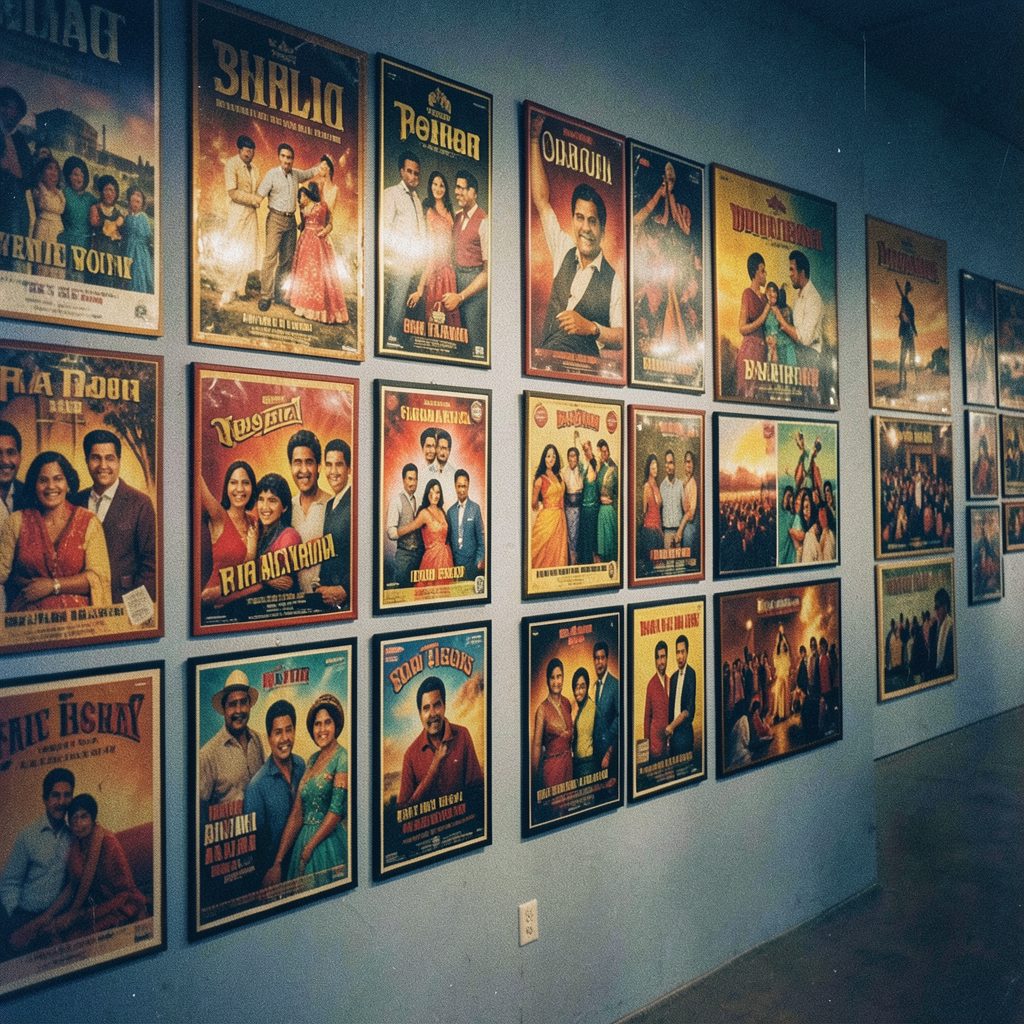
Something has to carry a performance into the decades, and in Hindi cinema it is often an image. Posters, stills, lobby cards and the wallpapers that fan pages recycle at full screen do more archival work than any awards ceremony. The economics of that image trade is patchy, and as covers between irony and art shows in the Italian context, a cover can be a self-portrait that jokes about the film it sells. Bollywood's poster artists have always treated a star's face as a performance in its own right.
For Australian fans those images are often the first encounter. A poster pinned up in a share house in Melbourne, a still passed around a Sydney film club's group chat, a wallpaper on a phone that never leaves the screen, and the performance gets circulated in pixels long before anyone sees the scene. Indian fans do the same with an intensity that borders on archiving, though the Australian version tends to be unofficial and hand-assembled: posters printed on home printers, stills saved without credits, wallpapers cropped to a single face.
What the record should say the next time
Two short lists summarise the argument, and both are deliberately limited. The turns that most obviously deserved a major award they never received:
- Balraj Sahni in Garam Hawa (1973), a performance critics treat as the high-water mark of Hindi acting
- Naseeruddin Shah in Albert Pinto Ko Gussa Kyoon Aata Hai (1980), still unclaimed by any award body
- Om Puri in Ardh Satya (1983), his most restrained and most revealing work
- Smita Patil in Mirch Masala (1987), dismissed while her earlier win was celebrated
The cases where recognition arrived late, in another film, or not at all:
- Meena Kumari in Pakeezah (1972), whose National Film Award was announced while she was ill and collected only after her death
- Irrfan Khan, whose Haasil turned out to be the rehearsal for the praise that The Lunchbox received a decade later
- Shabana Azmi in Amar Akbar Anthony (1977), whose credit arrived mostly through retrospectives rather than a jury
- Dimple Kapadia in Ramaa Shaam (1984), still waiting for the recognition her performance earned
Judging Hindi acting by its award lists is like judging a country's music by its chart positions: accurate, useful and quietly wrong. The performances listed here changed the vocabulary of the form, showing how a walk to the bus stop can carry a whole history, how a taxi driver's singing can hide a verdict, how silence can hold a family together. The trophies belong to the industry that hands them out, and the memory of those turns belongs to the audiences who sat in the dark and watched them.